Do You Need Ballistic Gel Blocks?
Author: Mike Hardesty
That's a great question. Do shooters need ballistic gel blocks? My answer is, of course!
Why?
Short answer: They can help you solve problems you didn't know you had.
Let me explain by way of a personal story… I own a Diamondback SDR 2-inch-barreled .357 Magnum revolver, referred to as a snubby. I really like this gun… It's a six-shooter (not 5), it has good sights, and the cylinder comes out of the frame at the push of a button. It's a great carry gun for geezers like me who value wheelguns.
But I had a problem. I received some HoneyBadger ammo from Black Hills Ammunition in South Dakota to use in my reviews. This stuff is ferocious… It uses a light-for-caliber, machined, solid copper bullet with flutes in the nose that look like a Phillips screwdriver and comes out of a barrel faster than a scorched cat.
However, it can be ferocious on both sides of the muzzle… the loads kick pretty hard, especially in the plus-p and magnum calibers. Add in the revolver's light, 23-ounce weight, and that's a recipe for a painful palm.
Since the .357 load is a hard-kicker, why not carry the gun with .38 Special +P HoneyBadger loads? They are easier on the hand. But would they still be effective out of that short barrel? Would I get enough penetration, with a decent wound channel, out of the slower .38 Special loads?
There was only one way to find out. Don't guess. Test.
The Ballistic Gel Block I Used
I received a Clear Ballistics 10% Gel FBI Block. This block is FBI-calibrated and built to show exactly how bullets perform. The gel block was about as close to the real thing as I could get. It's clear gel that acts like real tissue. I figured that if it was good enough for the FBI, it's good enough for me.
Now, we will get to the bottom of this bullet penetration testing!
Why I Tested It
My experiment was very simple… if the .38 Special bullet came close to the penetration and wound channel that the magnum load exhibited, I would carry it. If it wasn't close, then the SDR would be stoked with .357s. Even though I could practice with .38 Specials, I prefer to practice with what I carry. That would lead to the painful palm syndrome.
My Testing Setup
Here's what I used:
- Firearm: Diamondback SDR 2" .357 Magnum revolver
- Ammo: Black Hills HoneyBadger .38 Special +P and .357 Magnum
- Distance: 10 feet
- Block: Clear Ballistics 10% Gel FBI Block
So, I grabbed the block, the gun, and the ammo and headed to my backyard range.
What Happened
I set the block on a table that wouldn't mind stopping an errant shot or two. I had a ruler handy, as well as the usual accessories for shooting.
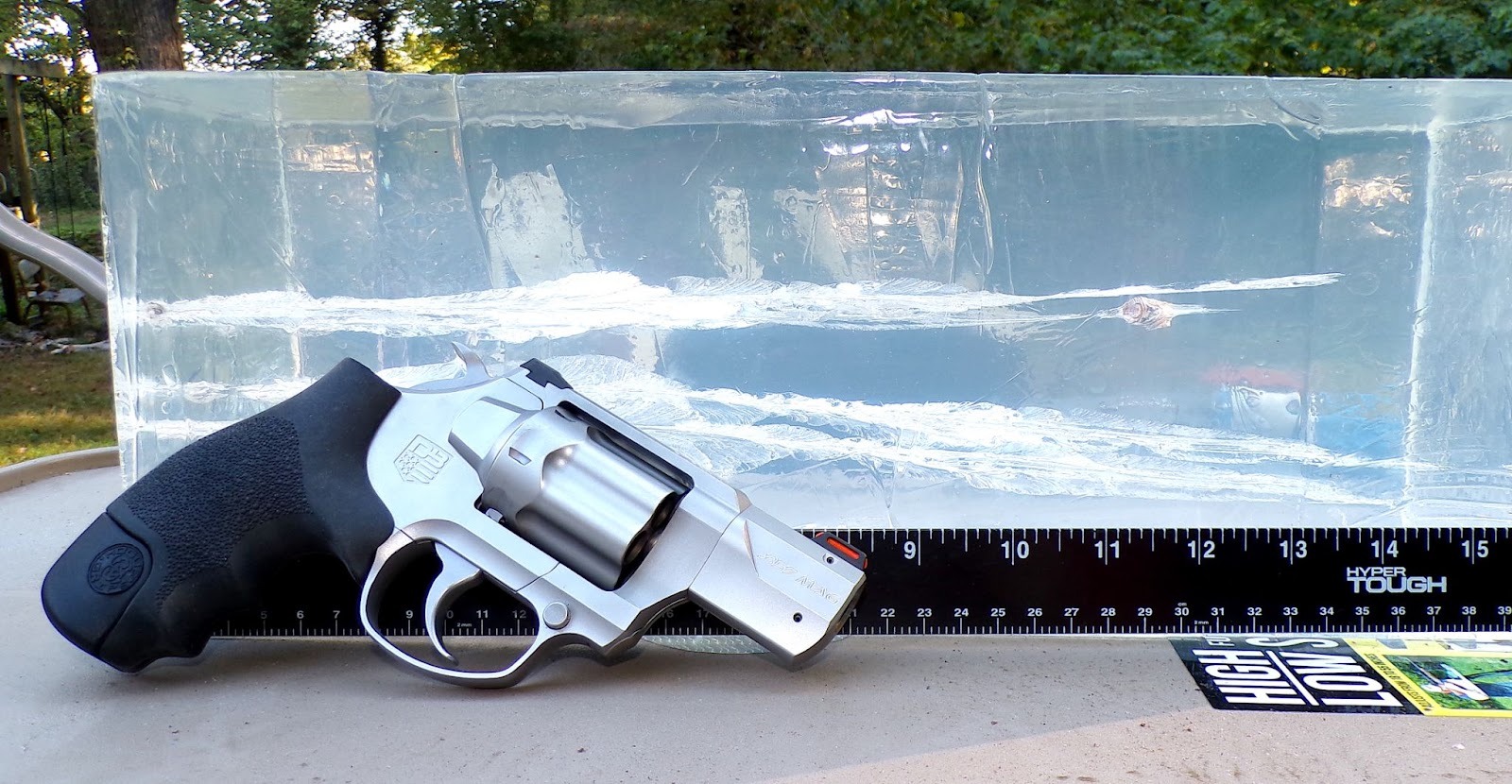
I placed the block on the table and stepped back ten feet. I tried the .38 load first… here's a photo of what happened:

Caption: .38 Special +P penetration and wound channel—12 inches straight through.
Penetration was exactly 12 inches. The wound channel was obvious.
Next, I loaded a magnum round and let fly with it. Here's what happened with that FBI gel test:

Caption: Confirming the results with a ruler. Twelve inches of penetration puts the .38 Special right where it needs to be.
I also didn't see any exit holes at first, but then I realized—the round went completely through the block. The .357 Magnum had so much penetration it blew right through, exceeding even the FBI's 12-18 inch standard. These HoneyBadger loads really are ferocious.
What I Learned
Well, I "got schooled." The results were very enlightening. As you can see from the photos, both bullets did well. Of course, the magnum load went in further—like, all the way out—and generated a larger wound channel, which I expected. The whole point of this experiment was to see if the .38 would come close… whether it would be a viable substitute or not.
After shooting both, I say yesirree. As you can see, the .38 exhibited decent penetration—12 inches—and wound channel characteristics. Again, not as much as the .357, but the .38 doesn't bite the hand that shoots it quite as badly as the .357 does, and those Lehigh Defense solid copper bullets tend to do the job. After looking at what happened with the .357, I wonder if it might exhibit a bit too much penetration. The FBI standard for that is 12-18 inches. I mentioned how ferocious these HoneyBadger loads are in terms of penetration… now I have visual proof of that.
Using gel blocks opens up other avenues of experimentation. Here's an example… my son and I want to see how his short-barreled, single-shot .45-70 bullets perform, since deer season is right around the corner. We will do that little test next. Hopefully, the one block will stop that bullet!
Pros and Considerations
So… what about Clear Ballistics gel blocks? Are they a viable testing medium? Of course, they are… many agencies use them. But I am not an agency.
The more important question is, are they a useful tool for an average shooter? Let's look at some pros and considerations…
Pros:
- Bullet performance (or lack of it) is immediately apparent, as the block is clear
- Penetration and wound channels can be empirically measured
- For reloaders and bullet casters like me, gel blocks are especially useful
- Guesswork is a thing of the past where bullet performance is concerned
- Blocks can be reused
- They are not affected by the weather
Considerations:
- Blocks aren't cheap—mine cost about the same as four boxes of ammo. But considering I can reuse it for dozens of tests, I'd say it's worth it
- They have some heft to them. If you're moving multiple blocks around, you'll feel it
- You'll need a spot to store them—they take up some space
- Reusing them takes a bit of prep time, though Clear Ballistics gives you instructions to make it easier
If you're new to gel testing, Clear Ballistics offers starter kits with everything you need. Do the pluses outweigh the considerations? You can decide for yourself, but for me, they sure do.
The Final Verdict
I started out with a ballistics question… does the .38 Special HoneyBadger load have enough "oomph" to justify substituting it in place of the .357 Magnum load in my lightweight snubby? Thanks to the Clear Ballistics 10% Gel FBI Block I shot into, I now have the answer to that question… yes.
Now I can practice with what I carry, without the painful palm. As a reloader and bulletcaster for decades, I have often wondered how my loads performed… now, I'll know. I have killed several deer with my .44 Magnum cast-SWC loads. It would have been educational to see the bullet's path, penetration, and expansion (if any) in gel test medium. At last, now I'll be able to do that.
Ballistic gel blocks are not required in order to be able to shoot, but whether you're a rifleman, a pistolero, a target competitor, a hunter, or some other type of shooter, by golly, they sure can be informative. This Clear Ballistics gel block made it possible for me to see exactly how my ammo performs—no guessing, just clear results. I highly recommend all serious shooters invest in a block or two… the one I used is about the price of four boxes of ammo. With it, you can see what your ammo really does.
Explore Clear Ballistics' full range to find the right size for your testing needs. I don't believe you'll regret it!