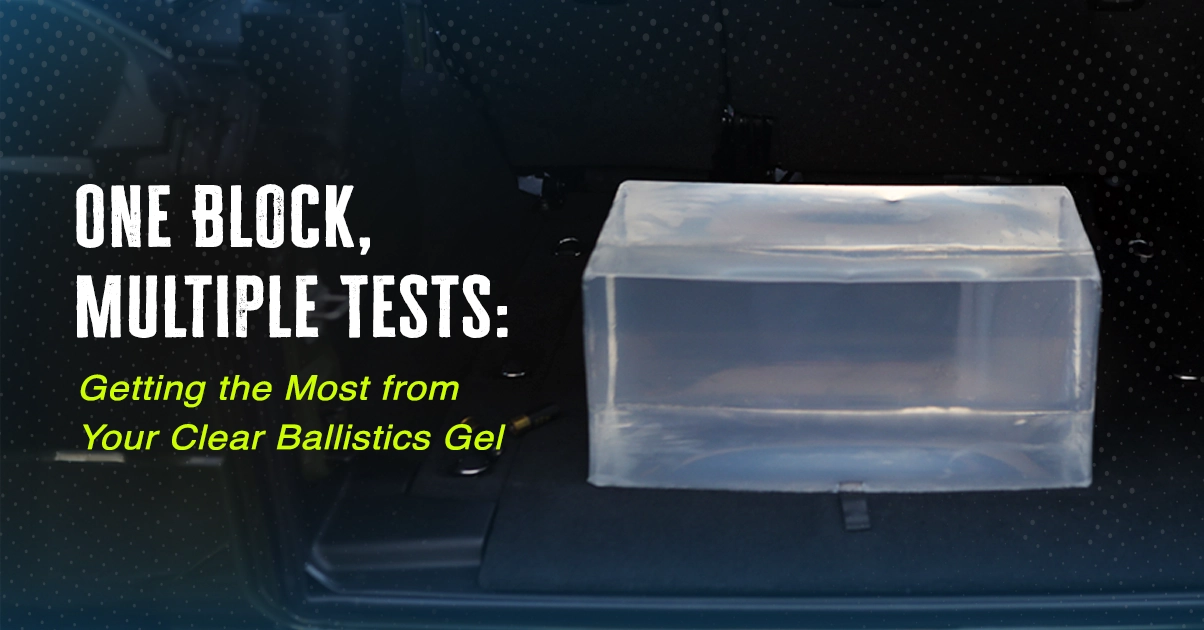
Maximizing Multi-Caliber Testing with One Gel Block
Gel blocks are becoming increasingly popular among shooters and reloaders. I know that I have benefited from the Clear Ballistics Gel FBI blocks I've received. They can be very informative in the data they provide, and those results get put to good use.
But what if you have more than one caliber you need to test?
The Block I Use
I've been using Clear Ballistics 10% Gel FBI Blocks for my multi-caliber testing. These blocks are FBI-calibrated and built for capturing multiple rounds while maintaining clear visibility.
The Problem
Ok. You decided to buy a gel block to help you find the perfect bullet. You placed it on a table or bench that wouldn't mind an errant shot or two. You grab your big blaster and the three loads you want to test.
You then proceed to ventilate your block with the three rounds, and notice perfect tracks through the gel, each one terminating in a lead "flower" of an expanded bullet. Success! That was great for your .223.
The only problem?
You own more than one rifle/handgun/shotgun, in more than one caliber/gauge. Now, what do you do in terms of ballistic testing? You've already put three tracks in your new, shiny block. How can you reuse the block?
My Testing Setup
- Firearms: Various rifles and handguns in multiple calibers (.22, .30, .38, .44, .45)
- Distance: 10-15 feet depending on caliber
- Block: Clear Ballistics 10% Gel FBI Block
- Method: Systematic approach using different techniques for maximum block usage
What I Do
There are a few things that you can do. Here are some ideas:
1. Vary The Caliber
First, you can shoot different calibers into the block. Let's say that you already have a few tracks of .22, .30, .38, .44, .45 in the clear block. It's a simple thing to just grab a different caliber, and let fly into the gel.
You might want to make a note of where the original tracks were, a simple diagram of the front of the block that shows the entry point for each of the original three. That way, the newer tracks will not only generate a differently sized track (because you're shooting a different caliber), but they will be obviously in different positions.
My approach:
If I have more than one load to test in different calibers, I try to start with the smallest, then move through the calibers to the largest. Those tracks are obvious in their size differential.
2. "Map" The Block
What do I mean, I hear you thinking. How do I map a gel block? Maybe map isn't the right word, but it hopefully conveys the idea of marking out, in advance, locations on the front of the block to place bullets into.
Here's how it works:
- Use a Sharpie to divide the block into different areas (or just do it mentally)
- Say you have four loads you want to check - divide the front into quarters
- Put all of your first caliber's shots into the "A" corner
- Move systematically through each section
Don't worry about the bullets hitting each other after they enter the block… the paths are unpredictable. Yes, the tracks seem to be straight, but a tiny variation in how you position the gun before firing can have a big impact on the bullet's track.
Unless you're firing off a rest of some sort, you won't need to worry about paths intersecting. But, let's say, worst case, two bullets cross paths and end up almost touching… unless you're in a ballistics lab, paying attention to the most minute details, it shouldn't affect the results very much.
Bottom line:
Mapping your block will allow you to get a lot of shooting out of it.
3. Turn It Around
Here's a thought… most bullets will have a slightly upward track as they enter the gel, depending on the angle that you hold the gun. So, if you spin the block 180 degrees, hopefully the different tracks coming from each end might look like "crossed swords" a bit.
This especially works if you shoot at a very slightly upward angle, from each end. If you do this, it is very obvious which track goes with which bullet.
The math:
If you've quartered both the front and the back of the block, you would have eight quadrants to shoot into.
4. And, Lastly – Remelt It!
Here is the one solution that will truly solve your problem and is not a stopgap. Simply remelt the block.
How, you ask? Order a remelting kit. These consist of:
- A melter (sort of like a big crock pot)
- A mold
It's pretty simple… melt the block and either ladle or pour the molten gel into the mold. Allow it to cool, and you have – voila – a like-new block. The bullet fragments can be removed prior to melting by cutting them out, or a simple straining process. You can either keep them for reference, toss them, or remelt them (the bullet caster in me speaks!).
Pros and Considerations
So… what about Clear Ballistics gel blocks for multi-caliber testing? Are they a viable solution when you want to test different loads without buying multiple blocks? Of course, they are… but I'm not running a ballistics lab.
The more important question is, are these methods practical for an average shooter like me? Let's look at some pros and considerations…
Pros:
- Multiple caliber testing capability
- Cost-effective approach
- Reusable up to 10 times
- Clear visibility of all bullet tracks
Considerations:
- Need to track shot placement carefully
- Eventual remelt required
- Bullets may occasionally cross paths
What I've Learned
These methods have let me test dozens of different loads without buying multiple blocks. Don't guess about your different calibers – test them. The FBI-calibrated gel gives consistent results, so you can compare results across tests with confidence.
Summing Up
It isn't hard to reuse your blocks. Simply employ one or more of the methods illustrated here, and you should be good to go. The important thing is not to let owning only one block stop you from putting different calibers into it… You can do that easily.
By varying the caliber, mapping, or turning the block, you should be able to glean valuable information from it. Eventually, you will want to remelt it… Depending on how well you clean the block before melting, you can remelt it 10-15 times before you'll need to replace it.
Choose Reusable Ballistics Gel for Your Next Test
Storing and reusing ballistic gel doesn't need to be complicated. With Clear Ballistics synthetic gel, you avoid spoilage, refrigeration, and inconsistent results. Simple storage keeps each block clean and stable. The ability to remelt and recast means you get more value from every test.
We design our gel to last. Every block is FBI-calibrated or NATO-calibrated and fully transparent. It can be reused many times without losing performance. Our products are built for shooters, manufacturers, and trainers who demand consistent results. From storage to reuse, Clear Ballistics makes testing straightforward and repeatable.
Clear Ballistics gel made it possible for me to get maximum value from my testing investment.
Frequently Asked Questions
1. How long do Clear Ballistics synthetic gel blocks last if stored properly?
Clear Ballistics synthetic gel blocks can be reused multiple times when stored properly. Keep them in a cool, dry place away from direct sunlight. Unlike traditional gelatin powder, our synthetic blocks are ready-to-use. They maintain their calibrated consistency shot after shot.
2. Can ballistic gel be frozen for storage?
No, ballistic gel blocks should never be frozen. Freezing ruins the gel's set structure and negatively affects its ballistic performance, whether before or after setting.
3. How should you clean ballistic gel blocks after use?
Avoid rinsing with water as it alters the gel composition. Instead, gently wipe the gel block with baby wipes or a damp cloth to remove dirt without compromising the gel's integrity.
4. How many times can Clear Ballistics gel be remelted and reused before it degrades?
Clear Ballistics synthetic gel can be remelted multiple times without losing consistency. Customers have successfully remelted up to 15 times, making it cost-effective and environmentally friendly by supporting repeated reuse.
5. Is it necessary to refrigerate synthetic ballistic gel?
No, synthetic ballistic gel from Clear Ballistics is shelf-stable between -10°F and 95°F (-23.3°C to 35°C) and does not require refrigeration.